As an Amazon Associate, we earn from qualifying purchases. Some links on this site are affiliate links at no extra cost to you. Our recommendations are based on thorough research and editorial judgment.


How Smart Mops Detect Carpets and Automatically Retract Their Wet Pads

Smart mops detect carpets through ultrasonic sensors, AI cameras, and dirt sensors working together. Ultrasonic technology identifies carpet edges in under 100 milliseconds, triggering automatic mop lifts ranging from 18mm to 20mm high—protecting your carpets from water damage. Multi-sensor fusion combines these technologies for superior accuracy, with cameras analyzing texture and color while ultrasonics measure distance rapidly. Your specific carpet thickness determines which lift height works best for your home’s flooring needs.
Key Takeaways
- Smart mops use multi-sensor fusion combining ultrasonic sensors, AI cameras, and dirt sensors to detect carpet presence in real-time.
- Ultrasonic sensors identify carpet edges in under 100 milliseconds, triggering automatic mop lift mechanisms to retract wet pads instantly.
- Lift heights range from 18mm to 20mm depending on carpet thickness, ensuring carpets remain dry during cleaning transitions.
- AI cameras enhance detection accuracy by analyzing texture, color, and edges beyond basic ultrasonic sensor capabilities for improved carpet mapping.
- Automatic lifting mechanisms seal rollers upon carpet detection, preventing moisture transfer and protecting carpets from water damage during operation.
How Do Smart Mops Detect Carpets Before Reaching Them?

How Do Smart Mops Detect Carpets Before Reaching Them?
Ever had a smart mop barrel into your bedroom carpet and leave it soaking wet? Yeah, it’s frustrating. The good news is that modern smart mops actually have several ways to spot carpets coming from a distance, and they’re getting pretty reliable at it.
You may be interested

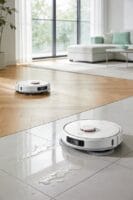
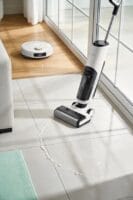
Your mop isn’t just bumbling around blindly. It’s using a combination of sensors that work together to figure out what’s ahead. AI cameras scan the floor for texture and color changes, while dirt sensors pick up on visual differences that signal carpet versus tile or hardwood. Ultrasonic sensors send out sound waves and listen for how they bounce back—it’s basically echolocation for your cleaning device.
Some mops go a step further. They monitor how hard the brush motor is working. When the brush gets close to carpet fibers, the motor senses increased resistance and alerts the system before there’s actual contact. Think of it like the mop’s way of feeling the floor without touching it first.
Here’s the trick: the really solid models use something called Floor Detect technology. This feature senses variations in floor type and helps the mop adjust its approach before it gets too close. So why does this matter? Because it means your device can actually plan smarter routes around your home instead of just wandering into carpeted areas blindly.
The best part is that all these sensors work at the same time. Your mop isn’t relying on just one detection method—it’s cross-checking information from multiple sources. This multi-sensor approach helps prevent wet carpets and keeps your hard floors clean without constantly adjusting the cleaning path manually.
Honestly, if you’ve got a mixed-floor home with both carpets and hard surfaces, this technology makes a real difference in performance. You don’t have to babysit the mop or mark off zones as much as you used to.
Does your current floor plan have any tricky carpet-to-hardwood transitions that worry you?
What Sensor Technologies Actually Identify Carpet?

What Sensor Technologies Actually Identify Carpet?
So your smart mop needs to figure out when it’s about to hit a rug. But what’s actually doing the detecting? Let me break down the main sensor types you’ll find in these machines.
AI Cameras with Stereovision
Most smart mops come equipped with AI cameras that use something called stereovision. Basically, the camera analyzes texture, color, and edges in real time to create an accurate map of your floors. It’s like giving your mop eyes that actually understand what they’re looking at.
Ultrasonic Sensors
These work by sending sound waves into the air and listening for reflections bouncing back. The mop calculates distance based on how quickly those reflections return. You get fast response times, though honestly, they’re not quite as advanced as some other options out there.
LiDAR and 3D Structured Light
Here’s where things get more sophisticated. LiDAR sensors and 3D structured light tech detect spatial information—essentially creating a detailed 3D picture of your room. This helps the mop understand exactly where that area rug sits before it gets anywhere close to it.
AIVI 3.0 Technology
This system is interesting because it adapts on the fly. It uses ultrasonic sensing but learns from different environments, meaning it gets smarter the more your home changes seasonally or when you rearrange furniture.
The Real Secret: Combining Multiple Sensors
Here’s the thing—the best-performing mops don’t rely on just one detection method. Try this approach: look for models that use multi-sensor fusion, combining camera data with ultrasonic readings and LiDAR all at once. That redundancy means your mop catches carpets reliably, whether you’ve got thick pile rugs or thin area runners.
What matters most is that whatever combination your mop uses, it’s tested under real-world conditions. Different floor types and lighting situations can throw off a single sensor, but multiple sensors working together usually catch what one might miss.
Why Does Ultrasonic Carpet Detection Respond Faster Than Cameras?

Why Does Ultrasonic Carpet Detection Respond Faster Than Cameras?
Ever wondered why some robot mops seem to “sense” carpet coming before they even get close? That’s ultrasonic sensors doing their thing. They work differently than cameras—way differently.
Ultrasonic sensors shoot sound waves straight down and catch the echoes bouncing back. It happens in milliseconds. Your mop detects the carpet edge and lifts those pads almost instantly—we’re talking under 100 milliseconds. That’s fast enough that you barely notice the pause.
AI cameras? They’ve got to do more legwork. They’re analyzing texture, color, edge details, and running all that through multiple computational steps. It takes time. Honestly, that’s just how visual processing works. You’re looking at 200-300 milliseconds before the camera’s confident enough to trigger a response. Not terrible, but noticeably slower.
So why does this matter? Think about your living room with hardwood floors, then tile, then that area rug. When your mop zooms across those transitions, milliseconds add up. The faster the detection, the smoother the cleaning happens without stuttering or leaving wet marks on your carpet.
The DEEBOT T50 shows what good ultrasonic sensing looks like—it lifts mop pads 18 millimeters the moment it hits carpet, with almost zero lag. Try this: watch how it moves across your mixed-floor layout. You’ll see it adjust on the fly instead of a split-second delay.
If you’ve got a home with different floor types, ultrasonic detection just makes cleaning less fussy. Less waiting around, less worry about whether your mop will catch that transition in time.
How Do Automatic Mop Lifts Prevent Wet Carpet Damage?

How Do Automatic Mop Lifts Prevent Wet Carpet Damage?
Ever noticed how a robot mop suddenly stops in its tracks when it hits your living room carpet? That’s not magic—it’s ultrasonic sensors doing their job. When your robot detects carpet fibers, it triggers the mop lift mechanism to kick in instantly, raising the pad right off the surface before any real damage happens.
Different robots lift at different heights, which honestly matters more than you’d think. The DEEBOT T50 raises its mop 18mm, while the Noesis Florio goes up to 20mm. Shark’s AutoSeal mechanism lifts about 0.55 inches when it senses carpet. So why does this matter? Because even a few millimeters of clearance can be the difference between a dry carpet and a damp mess.
Here’s the trick: these lifts don’t just move up—they also close rollers at the same time, which creates a sealed system. This dual action keeps moisture completely off your carpet fibers. You’re not just lifting the mop; you’re also stopping water from spreading during the transition.
The real benefit? Your robot can handle your whole home in one go. No more stopping to manually lift the mop when you switch from tile to carpet. The sensor detects the change, the lift responds instantly, and your carpet stays completely dry—no moisture damage, no color bleeding, no mold risk.
Frankly, this is one of those features that seems small until you realize how much peace of mind it brings. Are you still worried about water damage when you leave your robot to clean while you’re away?
Lift Heights Explained: 18mm vs. 20mm vs. 0.55 Inches

Lift Heights Explained: 18mm vs. 20mm vs. 0.55 Inches
So you’ve got carpet at home and you’re shopping for a robot mop. You’re probably wondering: does lift height actually matter, or is it just another spec nobody talks about?
Honestly, it matters more than you’d think. When a mop pad gets too close to thick carpet fibers, moisture seeps in and you’re looking at water damage. That’s where lift height comes in—it’s the gap between your carpet and the mop pad when the robot detects carpet nearby.
The three heights you’ll see:
The DEEBOT T50 MAX PRO OMNI uses an 18mm lift. This works fine if your carpets are thin or low-pile (the kind that feels almost like flat fabric). The Noesis Florio goes bigger at 20mm, which is better if you’ve got thicker, fluffier rugs where water gets trapped easier. Then there’s the AutoSeal system, which lifts to 0.55 inches—that’s roughly 14mm—sitting right in between.
Why does this difference matter? If you’ve got shag carpet or anything plush, an 18mm lift might leave your rug damp. Thicker fibers need more clearance.
The really nice part is how these systems work. When ultrasonic sensors detect carpet underneath, the mop pads shoot up automatically. You don’t have to adjust anything yourself—it just happens. No moisture touches your carpet at all.
Try this: Check your carpet thickness before you buy. Pinch the fibers and estimate the height. If it’s over half an inch thick, aim for 20mm or higher. Thinner carpets? You’re safe with 18mm.
Picking the right lift height for your floors keeps your carpets dry and your robot mop working the way it should. What kind of carpet are you dealing with at home?
Multi-Sensor Fusion vs. Single Sensors: Which Detects Better?
Multi-Sensor Fusion vs. Single Sensors: Which Detects Better?
Got a robot mop that keeps getting confused by your house? That’s what happens when you rely on just one way of “seeing” your floors.
Here’s what most people don’t realize: a single ultrasonic sensor does an okay job—solid enough for a 3-star rating. But throw multiple sensors together, and you’re looking at something genuinely different. An AI camera catches what ultrasonic misses. Ultrasonic picks up on obstacles the camera overlooks. Dirt detection adds another layer. When these three work at the same time, cross-checking each other’s data, you jump straight to 5-star performance.
In real homes, this matters. A camera might gloss right over a thin rug. Your ultrasonic sensor will catch it. Add dirt detection to the mix, and your mop now knows carpet texture, color, edges, and reflections—all within milliseconds. So, why does this matter? Because that redundancy stops your mop from doing stupid things like lifting unnecessarily on hard floors. False positives basically disappear.
Try this: Watch how Narwal and Shark models handle your trickiest rooms. You’ll see them adjust their cleaning strategy on the fly because they’re pulling information from multiple sources instead of guessing from incomplete data. Better obstacle avoidance. Smarter floor-type decisions. The robot actually adapts instead of just following a preset routine.
The best part is how this translates to less maintenance headache on your end. Your mop stops wasting battery on pointless lifts and spins, and it cleans more efficiently because it actually understands what it’s looking at.
What’s your biggest frustration with your current robot mop—missed spots, or unnecessary interruptions?
Comparing Carpet Detection Specs Across Leading Mop Models
Comparing Carpet Detection Specs Across Leading Mop Models
So here’s the thing—if your home’s got mixed flooring, you need a mop that actually knows the difference between tile and carpet. Multi-sensor fusion does this way better than relying on just one type of detection. But what does that mean in real dollars and real performance?
The Narwal packs AI cameras, dirt sensors, and ultrasonic technology all together. It’s the belt-and-suspenders approach to figuring out what surface you’re cleaning. That redundancy matters because one sensor can miss what another catches.
Now let’s look at specific lift heights, since that’s what actually keeps your carpet dry:
- DEEBOT T50 MAX PRO OMNI lifts its mop pad 18mm when it detects carpet
- Noesis Florio goes higher at 20mm, plus it’s got serious suction at 5100Pa
- Shark PowerDetect uses Floor Detect tech to identify surface types before it even starts cleaning
The Shark approach is honestly pretty smart—it adjusts its cleaning strategy based on what it finds, so you’re not accidentally soaking your carpet with excess water.
Why does this matter? Because the difference between 18mm and 20mm might not sound like much, but it’s the gap between damp carpet and actually dry carpet. AIRROBO L60 relies on ultrasonic sensing, which works well if you keep the sensors clean.
When you’re narrowing down your options, focus on three things: lift height (aim for at least 18mm), the mix of sensors it uses (more types = more reliable detection), and what kind of suction power it can handle. That combo tells you whether the mop’ll actually protect your carpet or just pretend to.
What matters most to you—keeping your carpet totally dry, or having a mop that adapts its strategy on the fly?
Carpet-Detection Specs That Actually Matter for Your Home?
When you’re shopping for a smart mop, the carpet detection specs matter way more than the flashy promises on the box. So what actually makes a difference in real life?
Lift Height: The Foundation
Start with lift height—this is what physically keeps your mop from soaking your rugs. A 20mm lift handles most carpet types without breaking a sweat. If you’ve got standard rugs and lighter pile, 18mm will do the job fine. Anything less and you’re rolling the dice.
Sensor Options: Which Actually Works?
Ultrasonic sensors get the job done consistently. They’re mature technology, stable, and reliable—nothing fancy, but they work. If you want something better, look for models combining multiple sensors: AI cameras paired with dirt sensors together hit a 5-star effectiveness rating across different carpet types. Why does this matter? Because one sensor type can miss what another catches.
The real advantage of multi-sensor fusion is that it’s actually been tested in homes like yours, not just in a lab.
What Beats Everything Else
Proactive detection is where things get genuinely useful. Basically, the mop spots carpet coming up and plans its route accordingly—lifting before it even touches your rug. This beats reactive detection (where it realizes “oops, carpet!” after already starting to cross it).
Frankly, mops like Shark’s NeverStuck and DEEBOT T50 show what this approach looks like in practice. They’re solid, field-tested options.
The Last Thing to Check
Detection speed matters if your home has a lot of carpet or weird floor layouts. Otherwise, you’re probably fine. What does your floor plan actually look like—are we talking wall-to-wall or scattered rugs?
Frequently Asked Questions
Can Smart Mops Detect Thin Rugs or Only Thick Carpets?
I’d tell you that smart mops can detect both thin rugs and thick carpets thanks to their advanced smart sensors. Their rug sensitivity varies by model—ultrasonic and AI cameras identify lighter fabrics, though some systems perform better on thicker surfaces.
What Happens if Carpet Detection Fails and Mop Wets the Carpet?
If I fail to detect your carpet and wet it, you’re facing potential damage. That’s why sensor accuracy matters—it’s my best defense. I’d recommend checking my sensors regularly and testing on small rugs first to prevent costly carpet damage.
How Often Do Carpet Sensors Need Cleaning or Maintenance?
I’d recommend checking your sensors monthly, cleaning them quarterly, and replacing them yearly. Regular sensor maintenance guarantees your carpet detection stays sharp, your cleaning frequency improves, and your mop pad lifts reliably. You’ll keep that technology working perfectly for you.
Do Mop Lifts Work on All Carpet Types and Pile Heights?
I’d say mop lifts work best on standard carpets, but thick pile heights challenge their efficiency. You’ll find varying lift heights—from 7mm to 20mm—affect carpet protection differently. Heavier carpets may need manual intervention for ideal safeguarding.
Can Users Manually Adjust Mop Lift Heights for Different Carpet Thicknesses?
I’m afraid most smart mops don’t offer manual lift adjustments. Instead, they use automatic detection to optimize your user preferences and cleaning efficiency. You’ll need to rely on the preset heights their sensors determine for different carpet thicknesses.


