As an Amazon Associate, we earn from qualifying purchases. Some links on this site are affiliate links at no extra cost to you. Our recommendations are based on thorough research and editorial judgment.


How Smart Mowers Are Using GPS RTK to Eliminate Perimeter Wires

RTK GPS eliminates buried wires by providing 1-3 centimeter accuracy, whereas standard GPS drifts 5-10 meters. You use a fixed base station that calculates atmospheric errors and sends real-time corrections to your mower’s rover receiver, creating stable virtual boundaries through smartphone apps. This system requires a minimum of 10 satellites and frequent updates—1-20 times per second—for reliable performance across properties up to 19.77 acres. Setup involves positioning your base station in open areas for ideal sky visibility. Understanding how these components interact reveals why professional landscapers increasingly adopt this technology.
Key Takeaways
- RTK GPS delivers 1-3 centimeter accuracy using real-time satellite corrections, eliminating the need for buried perimeter wires.
- Virtual boundaries are digitally mapped via smartphone apps, allowing easy updates and adjustments without physical installation.
- Base stations calculate atmospheric errors and transmit corrections to mower receivers, enabling precise positioning without ground wires.
- RTK systems support complex lawn layouts across properties up to 19.77 acres with multiple mowing zones.
- Virtual boundary setup requires only open sky visibility for the base station, simplifying installation compared to traditional wire systems.
What RTK GPS Is and Why Standard GPS Fails Lawns
What RTK GPS Is and Why Standard GPS Fails Lawns
Ever try to mow your lawn in straight lines and end up with something that looks more like a drunk zigzag? Standard GPS is the culprit. Your average GPS receiver can only pinpoint your location within 5-10 meters—that’s basically useless when you’re trying to keep your mower on a tight path or define where your lawn actually ends.
RTK Overview: The Real Solution
RTK stands for Real-Time Kinematic positioning, and honestly, it’s the difference between a mower that wanders and one that stays true. It works by taking regular GNSS signals (the satellite data your phone uses) and correcting them down to 1-3 centimeters of accuracy. So, why does this matter? Because those tiny corrections mean your mower knows exactly where it is, every single millisecond.
You may be interested



Here’s how it actually works:
A base station sits in a fixed spot on your property and constantly checks what the satellites are telling it. The atmosphere, buildings, and trees all mess with the signal—a problem called multipath interference. Your base station figures out those errors and beams corrections back to your mower’s receiver (the rover) through radio, Wi-Fi, or even your charging station’s connection. That instant feedback loop keeps your mower locked in.
Why Standard GPS Isn’t Enough
Standard systems just can’t do this. They grab a signal from satellites and hope for the best. There’s no correction happening in real-time, which means drift happens. Your mower drifts left. Then right. Then it cuts over last week’s line by half a meter.
Trees make it worse. Obstacles block signals. Frankly, regular GPS was never built for precision lawn work—it was designed for “get you to the grocery store” accuracy.
The best part is that RTK eliminates all these headaches at once. Centimeter precision works whether you’ve got thick tree cover or open sky, whether it’s sunny or cloudy. Your mower stays on course.
Does your lawn actually need this level of precision? If you want clean, professional-looking stripes and don’t want to babysit your mower’s path, RTK is worth serious consideration.
How RTK Achieves Centimeter-Level Accuracy

Tired of your lawn mower drifting all over the place? Standard GPS gives you 5-10 meter errors—which basically means your mower’s guessing where to go. That’s why RTK technology exists, and honestly, it changes everything about how precise lawn care actually works.
So here’s the deal: RTK doesn’t just grab satellite signals like regular GPS does. Instead, it reads the actual wave patterns those satellites send out. Your mower’s receiver picks up these carrier phase signals super frequently—around 1-20 times per second—and compares them against corrections from a base station nearby. That constant back-and-forth happens so fast (we’re talking milliseconds) that atmospheric interference and multipath errors basically disappear.
Why does this matter? Because that base station is constantly calculating what’s off with the signal and beaming real-time fixes back to your mower through radio or Wi-Fi. The two-receiver setup—one on the mower, one at the base station—cuts your positioning error down from several meters to just 1-3 centimeters.
Here’s the best part: you can map virtual boundaries with that kind of accuracy without burying any wires in your yard. Your mower knows exactly where it should and shouldn’t go. No guessing, no overlaps, no missed strips.
Want to know if RTK’s the right fit for your property?
How the Base Station and Rover System Work Together

How the Base Station and Rover System Work Together
Want centimeter-level accuracy on your lawn? It all comes down to two parts of your RTK system staying in constant contact: a base station that doesn’t move and a rover receiver on your mower that does.
Your base station sits in one spot—ideally somewhere with a clear view of the sky. It’s basically your system’s brain, pulling in satellite signals and figuring out what atmospheric errors are messing with accuracy. Meanwhile, your mower’s receiver gets real-time corrections sent through a radio link, Wi-Fi, or even your charging station. So, why does this partnership matter? Because together they shrink your positioning error from several meters down to just 1-3 centimeters.
Here’s the trick: this back-and-forth happens fast. We’re talking 1-20 updates per second, which means your system responds in milliseconds. Your base station calculates the errors, sends the fix to your rover, and the rover applies it right away.
The best part is you don’t need a ton of satellites for this to work smoothly. You’re looking at a minimum of 10 satellites to keep everything stable as you mow. Frankly, once you’ve got that setup dialed in, the precision just stays consistent across your whole yard.
Creating RTK Virtual Boundaries Instead of Buried Wires

Tired of digging trenches around your lawn every time you want to set up a robot mower? RTK-equipped mowers let you skip that whole mess entirely by using virtual boundaries instead of buried wires.
Here’s what makes this actually useful: you map out your lawn’s edges using your smartphone app, and GPS does the heavy lifting with accuracy down to 1-3 centimeters. No digging. No cables. Just digital lines that your mower respects like they’re real fences.
The real benefit? You’re not stuck with whatever boundary you created last spring. Want to shift things around because you added a garden bed or your lawn layout changed? Just adjust the app and you’re done. Boundaries update instantly—no trips outside with a shovel.
Think about this for a second: what if your mower could handle multiple zones across your entire property without a single wire running between them? With RTK technology, you can set up complex mowing patterns across areas up to 19.77 acres, complete with separate sections for different lawn areas. You can even experiment with new boundaries seasonally without any disruption to your system.
Mowers like the Ambrogio 4.50 Elite show how well this actually works in practice. They navigate wire-free without losing precision at the edges. Beyond the convenience factor, you’re also looking at real cost savings—no buried cables means no installation fees, and that flexibility in your setup pays dividends down the road.
The bottom line: virtual boundaries give you control, save you money, and let you adapt your mowing setup whenever you need to. So why wouldn’t you want to ditch the wires?
How Top RTK Mower Brands Compare
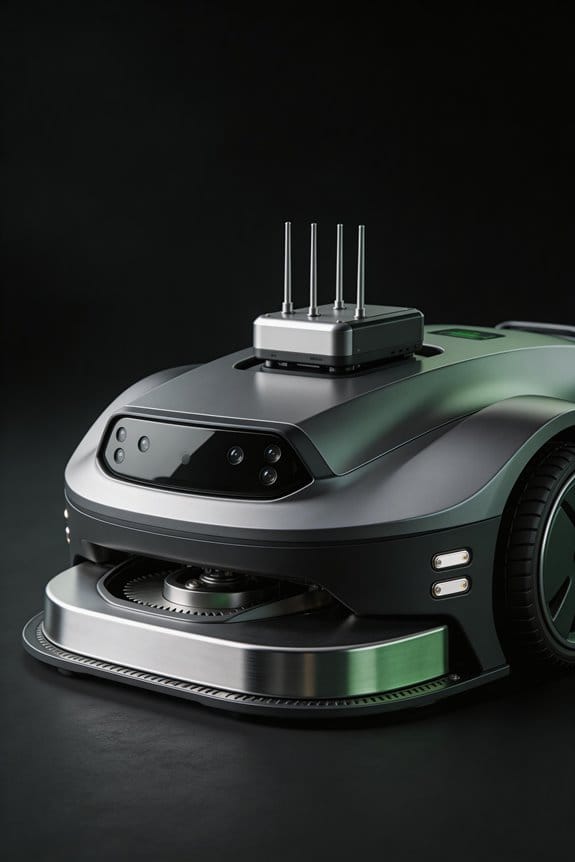
Thinking about buying an RTK mower? The choice between top brands can feel overwhelming, especially when you’re trying to figure out which one actually fits your yard and your budget.
The big names in the RTK space don’t all work the same way. Ambrogio’s 4.50 Elite is built for larger properties—we’re talking up to 19.77 acres without needing a perimeter wire. What makes it stand out is the centimeter-level accuracy it gets from RTK positioning. That precision matters if you’ve got a sprawling lawn and want clean, consistent cuts.
Navimow takes a different approach. It pairs EFLS 2.0 technology with visual localization, so it keeps working reliably even when you’re dealing with heavy tree coverage. Ever notice how some mowers lose their bearings under a thick canopy? That’s where Navimow‘s system shines. It doesn’t rely entirely on satellite signals, which is smart if your property has a lot of shade.
Yarbo RTK focuses on a specific challenge: sloped terrain. If your yard sits on a hill or has uneven ground that other mowers can’t handle, this brand was designed with that in mind. Segway Navimow, meanwhile, emphasizes smart navigation patterns—it mows systematically rather than randomly bouncing around.
So, why does the technical stuff matter? Because the differences really do affect how well your mower performs day-to-day:
- Correction coverage range: How far from the base station can your mower still get accurate positioning?
- Satellite acquisition speed: How quickly does it lock onto signals and start working?
- Communication reliability: Does it stay connected when things get tricky?
Frankly, the best choice comes down to your specific situation. Match the mower’s capabilities to your property size and how complicated your terrain is. What does your yard actually need?
How to Set Up RTK on Your Lawn
Tired of wrestling with buried wire boundaries or watching your mower miss spots? RTK setup might be exactly what you need to fix that.
The whole process comes down to three main things: getting your base station in the right spot, setting up your rover receiver, and making sure they can talk to each other. Frankly, it’s simpler than it sounds.
Getting Your Base Station Ready
Your base station is the brain of the operation. You’ll want to plop it in an open area where it’s got clear sky above it—no trees blocking the view. Why does this matter? Because it needs to grab signals from at least 10 satellites to work reliably. Think of it like getting a strong WiFi signal; the fewer obstacles, the better it performs.
Configuring Your Rover
Once your base station is humming along, it’s time to set up the rover receiver on your mower. This is where the real accuracy comes in. You’re looking at positioning that’s accurate to about 1 to 3 centimeters—tight enough to handle your yard without any guessing. The rover takes those correction signals and adjusts your mower’s position in real time.
Making Them Talk to Each Other
The communication link is what ties everything together. You can use radio, WiFi, or even run the signal through your charging station. Pick whatever works best for your setup.
What You’ll Actually Need
Your equipment list is pretty straightforward: a base station unit, a rover receiver, and whatever communication hardware fits your situation. Once it’s all connected, you ditch those old buried wires and map out virtual boundaries right from your phone instead. You can handle yards up to 19.77 acres with systematic mowing patterns that actually follow your yard’s layout.
Ready to try it out?
Fixing Common RTK Signal Issues
Fixing Common RTK Signal Issues
Your base station is perfectly placed. Your rover’s calibrated. So why’s your mower suddenly drifting all over the place? Truth is, even the best setup can run into signal trouble when trees, metal structures, or dense buildings get in the way. When RTK corrections get blocked, you’re looking at accuracy dropping from 1-3 centimeters down to several meters—not ideal when you’re trying to keep those lines straight.
Start by checking your base station’s sky view. Honestly, obstacles blocking just 30% of satellites will noticeably tank your performance. Your mower needs a minimum of 10 satellites to stay stable; drop below that and you’re dealing with dropouts that’ll leave gaps in your lawn.
Here’s the trick: reposition your base station away from reflective surfaces. Metal roofing, metal fencing, even certain types of siding bounce signals around and create what’s called multipath errors—basically, your receiver’s getting confused by signals bouncing off objects instead of coming straight from the sky.
Why does this matter? A weak signal doesn’t just slow you down; it compromises the whole point of having RTK in the first place. Most apps have error correction features built in that’ll help you spot weak zones before they become real problems.
Try this: move your base station just 6–10 feet in a different direction. I’ve found that small shifts often make a measurable difference in signal strength. Testing consistently shows you can restore centimeter-level accuracy with just a little repositioning.
Still having issues? Use your app’s error correction tools to identify exactly where the dead zones are. Once you know the problem spots, you can plan around them or adjust your base station placement accordingly.
What’s your current setup running into—persistent dropouts in one area, or are problems scattered across your yard?
RTK ROI: When the Investment Pays for Itself
An RTK-equipped mower costs $3,000 to $5,000 more than a standard GPS model. That’s real money. So the question becomes: does it actually pay for itself, or are you just throwing cash at the latest tech?
Honestly, it depends on your situation. If you’re mowing anything over 10 acres, the math starts working in your favor pretty quickly. RTK’s centimeter-level accuracy means you’re not making redundant passes over the same ground. No overlap, no wasted fuel, no unnecessary wear on your blades. Those savings compound every single season.
Here’s what the numbers typically look like:
- Labor hours cut down significantly
- Fuel consumption drops when you eliminate overlapping passes
- Blade wear decreases with more efficient coverage
- Equipment lasts longer overall
For most people running 10+ acres, you’re looking at recovering that upfront cost within 2 to 3 years. After that? It’s pure savings.
Now, if your lawn is under 5 acres, frankly, it’s tougher to justify unless you’re running professional maintenance contracts. The efficiency gains don’t add up enough to offset the price tag on a smaller property.
The real trick is figuring out what your time is actually worth. Are you spending an extra 2 hours every week mowing overlapped areas? What’s that time worth to you? When you put a number on it, RTK suddenly looks a lot smarter. Try this: calculate your current annual mowing hours and multiply by what you’d earn doing something else. That’s your real baseline.
The best part is that once you factor in reduced fuel costs and longer equipment lifespan, you’re not just saving time—you’re saving actual dollars every season. So take a hard look at your property size and maintenance schedule. Does RTK fit your operation?
Frequently Asked Questions
Can RTK Mowers Operate Safely Around Pets and Children Without Perimeter Wires?
I’ll answer your question directly: Yes, RTK mowers can operate safely around pets and children without perimeter wires. Their centimeter-precision virtual boundaries let you define pet proximity zones in your app, ensuring safe operation while your family plays freely nearby.
How Does Weather, Especially Heavy Rain or Snow, Affect RTK Mower Performance?
I’ll tell you: heavy rain and snow greatly degrade RTK performance since moisture saturates soil and clouds obstruct satellite signals. Weather impact reduces your mower’s positioning accuracy, though most models resume normal operation once conditions improve.
What’s the Typical Lifespan and Maintenance Cost of RTK System Components?
I’d say RTK system components typically last 5-10 years, with base stations being most durable. Your cost analysis should budget $200-500 annually for maintenance, including antenna checks, firmware updates, and potential receiver recalibration to keep everything running smoothly.
Can Multiple RTK Mowers Share the Same Base Station Simultaneously?
Yes, I can tell you that multiple RTK mowers absolutely share the same base station simultaneously. The base station broadcasts shared signals supporting simultaneous tracking for several rovers on your lawn, making it cost-effective for managing multiple mowers efficiently.
Does RTK Work Effectively in Urban Yards With Nearby Buildings and Structures?
I’d say RTK’s “environmental sensitivities” can challenge urban landscaping projects. Buildings create multipath interference, weakening satellite signals. However, I’ve found that combining RTK with visual localization helps overcome building obstruction, though you’ll need strategic base station placement for peak performance.


